
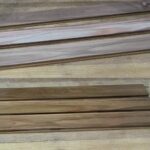
To demonstrate the stability of Accoya, we conducted multiple rounds of a stability test. We took Accoya, White Oak, and a thermally modified product and then applied a finish on one side of each board (which you should NEVER do), and placed them on a flat surface to bake in the hot summer sun for days (also NEVER do).
Each sample tested was short in length. With our experimental setup, we created the perfect environment and “recipe” for cupping boards. After a period of time, we brought the pieces inside to demonstrate the amount of rock each board has.
THE RESULTS
The result is cupping for White Oak and slight cupping for the thermal modified product, but Accoya still shows little to no movement. This is a direct result of Accoya’s acetylation process, making the wood less chemically capable of bonding to water resulting in less wood movement.
Accoya’s Chemical modification
Accoya takes a different approach to stability through modification. Whereas many manufacturers achieve stability through thermal modification, Accoya’s approach is through chemical modification. Accoya undergoes a process called acetylation. To summarize, wood has two chemical groups: hydroxyl and acetyl groups. Hydroxyl groups bond to water much more easily than acetyl groups do.
During acetylation, Accoya uses acetic anhydride to convert many of these hydroxyl groups into acetyl groups, significantly reducing the wood’s ability to absorb moisture. Because the cell walls take up far less moisture as humidity changes, they experience dramatically less swelling and shrinking. The result is a wood product with exceptional stability and significantly reduced movement compared to untreated wood.





Leave a Reply