

What’s with the Lumber Fraction terms?
We lumber guys have our share of lingo and obscure terminology just like any industry. Lumber thickness terms like 4/4 or 8/4 is a perfect example of one of those terms. What I find interesting about the lumber industry is that we expect our customers to also understand our lingo just to be able to buy our products. There is nothing that exemplifies this paradigm more than how lumber folk talk about thickness of a board in “quarters.” For example, when referring to a 1″ thick rough sawn board we say 4/4 (4 quarter), a 2″ board is 8/4, etc. Just do the math and reduce the fraction, and you get the actual or “nominal” thickness of the board. Beyond telling you how thick the board is, there is a bit more implied by the use of the “quarter” terminology. I can’t guarantee that I can apply any sense to this convention, but I hope I can clear up what we mean by it and make your next lumber purchase a little friendlier.
The 4/4 Origin Story
Hey, it works for Marvel Studios right?
There is a lot of uncertainty when all of this started. I had my own theory which seems to have been confirmed by several others, but I went searching for answers amongst my colleagues and to several sawyers.
The quarter increment became the lowest logical denominator over time and as standardization became more necessary as lumber production moved away from a local industry to regional and national distribution. 1/2 increments meant too much waste, and 1/8 increments is just ludicrous with way too many stock sizes to maintain.
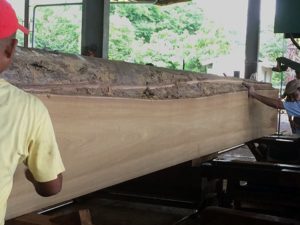
The “quarter” refers to the stops on the log carriage that slide the log over and locks in the thickness of the resulting board. With 1/4″ being as close to the standard, these stops were set up to mirror that, and when the sawyer bumped the log carriage over to the 4th quarter, he ended up with an approximately 1″ thick (or 4/4) board.
Still without fail, everyone I talked to initially scratched their head, and not one person was entirely certain of the origin of the convention. I added it up, and between all the people I asked, there are a collective 480 years of lumber sawing and dealing experience. Gotta love when something that is said every day has an origin shrouded in uncertainty.
Thanks for the History Lesson, Why Should I Care?
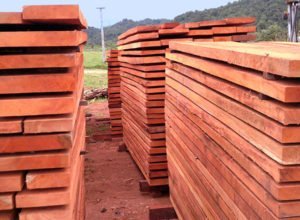
First of all when you hear someone use a “quarter” thickness term, you can be pretty certain they are talking about rough sawn lumber and, specifically, a nominal dimension that will net out smaller once the board is jointed and/or planed.
unless of course you hear someone say 3/4…that is an actual dimension not a rough sawn dimension. Put a pin in that, I’ll get to that later…deep breath, I promise this will make sense…maybe
So if I sell you a 5/4 board and you put a tape measure on it you will find it to be approximately 1 1/4″ thickness. It will have a rough, wavy surface however so once it is planed smooth or surfaced on both faces (S2S, surface on 2 sides) it will net something much closer to 1″. This tells you something automatically about the nature of the product in question and that you had better be prepared to do some millwork to that board when you get it. Put simpler, a board sold in quarter dimensions is further up the manufacturing process chain.
So a 3/4 Board is Meant to be Planed to a Half Inch??
Right now I’m laughing as I type this because yeah, nothing is ever simple in this business. No a 3/4 board is actually 3/4 of an inch and you can expect that to be a milled board with a precise 3/4″ thickness. Look at it this way. The quarter lumber thickness term stops at 4/4. This is the thinnest dimension. If you hear 3/4 or 7/8 or 5/8 etc this is referring to a milled dimension. Frustration right? Don’t even get me started on the 2×4, 1×6 nominal vs actual dimensions. That’s a whole other article you can read once your rage from the 4/4 confusion abates.
Pricing for Rough Thickness Boards
Second thing you can count on when you hear something like 8/4 is you will know how your lumber will be priced. By the board foot: a volume measure. Rough lumber has to be sold this way, because there are many variables at play starting with the size of boards coming out of the log. While the thickness may be set by the log carriage, the fast cutting blade will produce some variability in thickness over the length of a board. Moreover the width of the boards will change based on the log shape. The lengths of the boards can be pretty random as well. So lumber is packed in cubes where the volume can be easily determined and a price set by the board foot. This can then translate further as that initial lumber pack is broken apart into individual boards and the volume of each board can be determined should one want to buy boards one at a time.
Quarter Thicknesses Account for Drying Shrinkage
Next, the boards will have to be seasoned, and they are either air dried or kiln dried, shrinking them even further. The goal is to have the board shrink to the 4/4 (or whatever thickness is desired) once it is dried. This means the green sawn board might be closer to 1 1/4″ thick. Most sawyers these days have a lot of experience, and they know how thick they need to cut their boards to end up with 1″ thickness after drying, but there will always be a bit of variability due to the organic nature of wood. But if you buy lumber by the volume, you know what quantity you will be getting, even though there may be some inconsistency from one individual board to another. 1000 board feet of Cherry is the same amount, just like a gallon of milk is the same regardless of the store where you buy it.
On the converse is linear foot pricing. When you see wood sold this way. you know that it has been planed on at least 2 faces (S2S) or maybe all 4 faces (S4S). This price starts with the board foot cost, then factors in the labor for milling the boards to a set dimension. Now you know your exact dimensions of each board (thickness and width) and usually an average length is specified as well. The end product is something that has quite a bit of work already done on it, and it is either ready for joinery or ready to be installed.
The origins may be mysterious, but the reasons we sell by volume and use a specific quarter thickness convention are still valid today, just as they were centuries ago. As a consumer of lumber, now you know what all these fractions are about. But more importantly, you know immediately what condition your lumber will be in when you hear 12/4 or 8/4, etc.





Extremely handy to know, it’s only too bad there aren’t enough lumber yards left around to need to use it. I only know of 2 outside Chicago that still sell rough sawn and even that’s becoming scarce. Everyone around a city wants everything ready to go, no patience.
Hi Darren – I am also in chicago. Where do you buy your lumber? I wouldn’t say Owl is rough sawn – most everything they sell has been skip planed down to near s2s. Curious if there are other sources. I buy from a few specialty mills, but they are dealing more in slabs than boards nowadays.