Douglas Fir Lumber
Pseudotsuga Menziesii
The Douglas Fir tree can really be broken into two distinct varieties: coastal and Rocky Mountain. J. Gibson McIlvain Co supplies the coastal variety almost exclusively, because it grows much larger and produces a higher yield of structural timbers for our timber framing customers.
Despite its name, Douglas Fir is not actually a fir (genus Abies), but it shares many common features with Hemlocks and has been grouped with them in common usage. The wood has very straight grain with creamy-yellow earlywood and red-brown latewood lines that give the wood an overall orange cast in color. The distinct hardness difference between early and latewood lines can make for milling issues, and tool edges must be kept sharp to prevent tear out and splintering.
Douglas Fir Timber
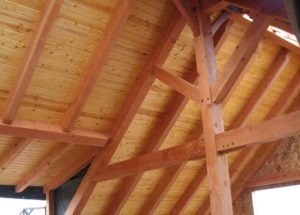
Douglas Fir lumber has become the standard wood of choice for timber framing and exposed beam building due to the high availability of large timber sizes. The tree is quite large, so large cants over incredible length are easy to obtain. Moreover, the structural characteristics of Douglas Fir mean that it has great stiffness (little deflection) over large spans. Douglas Fir timber is often graded by structural grades, but it can also be obtained in appearance grades for projects where the frame will be visible. Appearance and structural grades are very different, so it is important to specify which is necessary for your particular project.
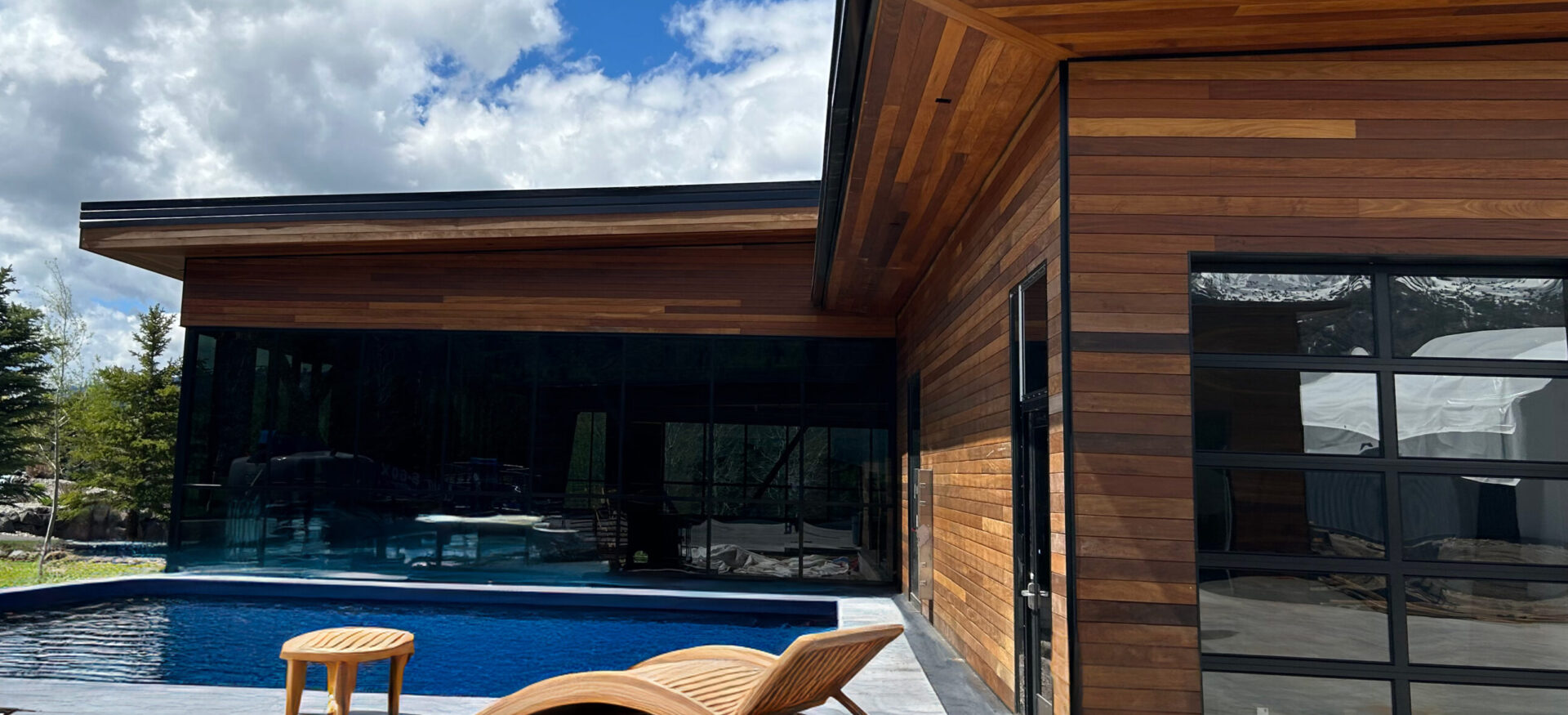
Outside of traditional timber framed structures, Douglas Fir wood has great applications in thinner stock sizes too. Here the clear and vertical grain grades and cuts are the preferred specifications. This makes a great option for exterior siding, flooring, and paneling in more rustic buildings.
Douglas Fir is a native species in the Pacific Northwest, and these days it is mostly sourced from British Columbia, Canada. Although the species has a wide range up and down the western coast of North America, moving large timbers more than 3000 miles to east coast projects can be both cost prohibitive and time consuming. J. Gibson McIlvain tackles this supply chain problem by maintaining a large stock of Douglas Fir lumber and timbers at our headquarters in Maryland. At the same time we have been working with sawmills in the Northwest for centuries and are able to source direct from those mills and have orders custom sawn for delivery anywhere in the US, Caribbean and Hawaii. While we appreciate lead time on orders for large projects, we have the ability to deliver to anywhere in the country for in stock sizes.
Douglas Fir structural timbers are available on a special order basis. We carry a wide range of rough sawn sizes in typical 4/4 and 8/4 lumber and supply it kiln dried or radio frequency kiln dried for a 100% dry large timber. Our millworks can manufacture Douglas Fir products for you like mouldings, paneling, or whatever you can dream up.
DOUGLAS FIR Wood SPECIFICATIONS
| Character | Green | Dry | Units |
| Bending Strength | 7682 | 12850 | psi |
| Crushing Strength | 455 | 890 | psi |
| Max Crushing Strength | 3852 | 7465 | psi |
| Static Bending | 4665 | 8600 | psi |
| Impact Strength | 25 | 36 | inches |
| Stiffness | 1523 | 2000 | 1000 psi |
| Work to Maximum Load | 7 | 10 | in-lbs/in3 |
| Hardness (Janka) | – | 710 | lbs |
| Shearing Strength | – | 1130 | psi |
| Specific Gravity | 0.45 | 0.50 | – |
| Weight | 39 | 35 | lbs/ft3 |
| Radial Shrinkage | – | 5 | % |
| Tangential Shrinkage | – | 8 | % |
| Volumetric Shrinkage | – | 12 | % |
Common Douglas Fir Lumber Sizes in Stock
- 4/4, 5/4, and 8/4 Rough 4″ – 12″ kiln dried, vertical grain
- 1 X 4 – 1 X 12 C and better S4S
- 2 X 4 – 2 X 12 C and better S4S
- 1 X 4 – 1 X 12 CVG (clear vertical grain) S4S
- 4″ and 6″ Tongue and Grooved Beaded edge
- 4-8 x 4-12 structural timbers in #1 Appearance and Select Grades, Freed of Heart Center