As an importer of record in many exotic species like Genuine Mahogany, Teak, and Ipe; J. Gibson McIlvain is acutely aware of the stigma attached to rainforest wood species and the spectre of global warming that looms over our industry. The facts are that deforestation is not a result of the lumber import trade, but in many cases caused by the disruption of it. Additionally, regulation by local, federal, international, and corporate entities provides a clear provenance of the lumber from forest to lumber yard that can be tracked, verified for sustainability, and monitored for trends. Over the next few weeks, this blog will examine the lumber import trade and tackle this assumption that what we, as a lumber importer, do is hurting our forests and our environment.
Logging Bans Cause Deforestation
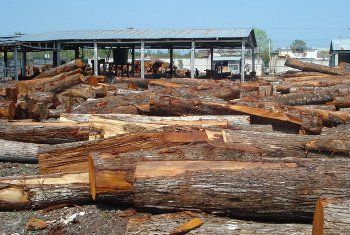
What happens when an area of forest is suddenly banned from logging? The heading to this paragraph may sound like political spin from a company trying to prevent its products’ supply chain from being stoppered, but it can be validated with a simple analogy.
Remember when flat screen televisions first came on the market, and the higher costs were being spun in many way to encourage buyers? One particular point was the lower energy consumption and green nature of their components as compared to the cathode ray tube set. Government regulations also started to grant incentives for users to ditch their CRT sets and go “green.” Flat screens became the new aesthetic, and the CRT market melted away faster than a snowball at the equator. Plenty was published about the environmental hazards of the inner workings of a CRT monitor and how to properly dispose of them. The reality is that in the eye of the owners, their 36″ CRT behemoth was essentially worthless, took up space, and was a nuisance. Was proper disposal protocol observed? Probably not. When an item has little to no value, it is discarded as quickly and easily as possible. Today, many cracked CRT monitors are sitting in our landfills and dumps leaching toxins into our soil.
Okay, I’ll admit this is not a perfect analogy as it is a case of one product becoming obsolete. The fact that the obsolete product was discarded haphazardly despite warnings of the hazards associated with it is the key point to consider.
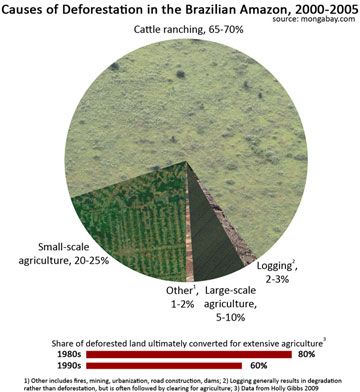
Now, let’s look at a Mahogany forest in South America. Outrage over the lumber trade’s responsibility for deforestation causes the levy of a logging ban. Sawmills shut down, jobs are lost, and a valuable timber resource suddenly loses all value. Landowners are then forced to find a way to derive value from their land. Instead of logging it for profit, they choose to burn it to make room for soybean crops or fields for cattle grazing (with buyers readily available for either soybeans or meat). As the landowner, they have every right to do so to their land, and now there is one more bald patch in the rainforest.
This is the reality. Logging has practically nothing to do with deforestation. In a great article at Mongabay.com, the chart at right lays out the causes of
How do I protect the rainforests? Buy imported lumber
Lumber importers the world over are members of IWPA and rely heavily upon their knowledge and influence to help us all dispel the myth that the lumber trade is responsible for deforestation. In fact, we may be the biggest fighters against it. IWPA’s website is a great resource for more information on this topic, and their Q&A guides are a great place to start to find out how you can be sure the lumber you are buying is helping our global environment.
Now, let’s get real. There are always a few rule breakers right? Maybe the lumber industry isn’t exploiting the rainforests, but there must be some opportunists who don’t think long term.
How do I know that my lumber was harvested legally and responsibly?
Next week we will begin to look at the journey of the tree from the rainforest to the ports and how we can ensure our suppliers are thinking about the future of the environment.
Learn more about the lumber industry:







Hey Shannon,
I think there are a couple of issues that have lead to the negative impression surrounding imports.
First, there’s the unsavory history of American clear-cutting practices of the past. Many of us… umm…mature adults well remember miles of denuded mountain sides as we drove through the West. Oh, and the loss of so many Giant, and Coastal, Sequoia groves. Couple those memories with a general disbelief of anything said by the titanic American wood-products companies, it’s almost certain that companies like McIlvain get caught in the fallout.
The second thing is that many environmentalists behave like Chicken Little, and far too many USAians are so concerned about the next paycheck, or too lazy, or ignorant, to understand the details. Deforestation is a widespread, and very serious problem. Many of the people that brought the issue to the public conscience, however, take the position that every tree harvested, for any reason, will hasten the demise of all the forests in the world; reality and economics be hung!
A basic economic truth; If you want to preserve something, make it valuable.
Anyway, nice article. I look forward to the rest.
Excellent points and we see this attitude from the locals in the tropical regions all the time. One thing the environmental organizations are doing is making it possible for a paycheck to be had when practicing sustainable forestry. Still it is hard to fight the quick buck that can be gained when some countries will buy any lumber regardless of origin and silvicultural practices. All we can do is shine a light on it and educated our customers how to buy responsibly. One of the things we are passionate about is killing this reputation many lumber companies have earned in the past centuries for being unscrupulous by drawing back the curtain on everything we do and pouring out lots of information about all the behind the scenes operations. Spend a small amount of time on this blog and you will see what I mean. Though I’m flattered you think so, I don’t think our little family run operation can be lumped in with the “titantic” wood companies.
It is true that logging only makes up for a small amount of trees cut down as a percentage of the total deforestation taking place. There are two points to consider though. First, most of the damage that is being done during logging, (both legal and illegal) is through the building of roads. The vast amount of deforestation that is happening is at the hands of farmers, who use slash and burn to prepare the land for crops or grazing. After the timbermen have built their roads, logged, and left, these roads remain allowing farmers easy access to areas not accessible before, thereby greatly speeding the process of deforestation. The second point is that these ecosystems do not respond the way that northern coniferous and deciduous forests do when logged. Here we can clear cut, leave it alone and in 50 years a forest has taken it’s place without much long term harm haven taken place, except under the extreme circumstances where erosion is a problem. Tropical areas are much more sensitive and take much longer to grow back with some areas never recovering their original biodiversity.
For me, I honestly don’t know what the solution is. I do know that “sustainably harvested” exotic timber is a bit of a misnomer because we really don’t know enough about tropical forests to know what they can actually sustain. I also know what we need to stop using tropical timber for ridiculous uses such as plywood, endless boardwalks, and veneer to cover throwaway furniture. We need a long term vision for these amazing forests that allows for their use, but also helps preserve them.